Brazilian dollar bonds: more than an emerging-market carry trade

Brazilian bonds are often viewed as a tactical allocation within emerging markets, primarily sought for their yield. Yet in Brazil’s case, this perspective captures only part of the opportunity: the country combines a diversified economy, abundant natural resources, globally relevant companies and a sophisticated financial system.
For international investors, hard-currency corporate bonds provide attractive income while offering exposure to sectors ranging from agriculture and mining to energy, infrastructure, utilities and financial services.
Scale and Diversification: A Distinctive Emerging-Market Profile
Brazil combines a large domestic market with competitive export industries. Consumption, infrastructure, financial services, manufacturing and utilities coexist with businesses linked to global trade and commodity markets.
This diversity creates a corporate universe exposed to multiple economic drivers rather than a single source of growth, giving credit investors access to a wide range of business models and cash-flow profiles.
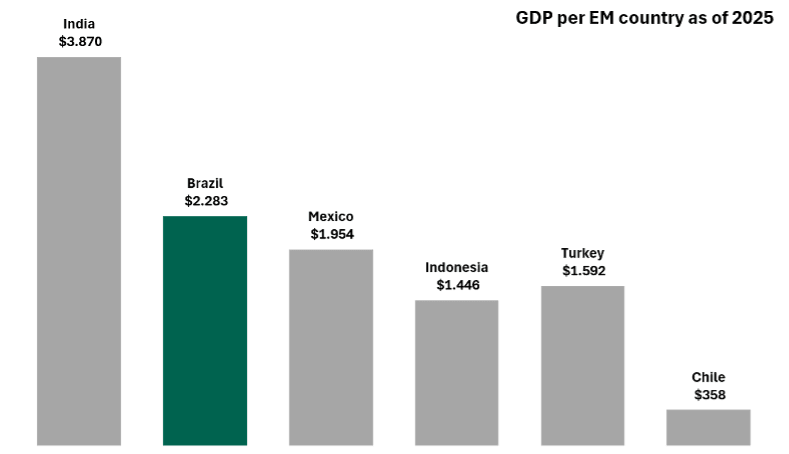
Font: Bloomberg
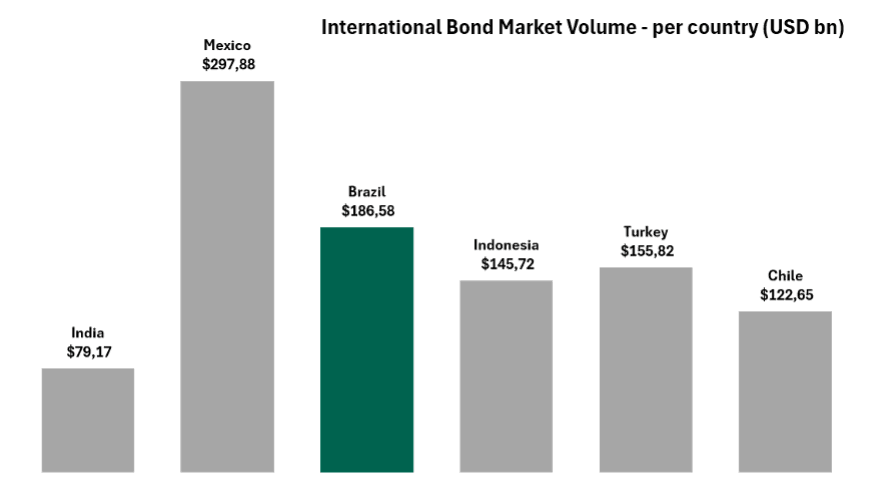
Font: World Population Review
Exposure to Globally Relevant Businesses
Brazilian companies play important roles in agriculture, mining, energy and infrastructure, while financial institutions, industrial companies and consumer businesses benefit from one of the world’s largest domestic markets.
Many exporters generate revenues linked to international prices. For some issuers, hard-currency revenues can also provide a natural alignment with hard-currency debt service, allowing investors to access global demand without direct contractual exposure to the Brazilian real.
Natural Resources as a Structural Advantage
Brazil is a major global producer of soybeans, coffee, sugar and beef, alongside corn, cotton and cellulose. It is also a leading iron-ore exporter and an increasingly important offshore oil producer.
This diversified resource base provides exposure to several sources of global demand and long-term themes including food security, energy supply and infrastructure investment. Brazil’s renewable-energy potential further reinforces its strategic position.
A Financial System Shaped by Complexity
Decades of inflation, currency volatility and changing interest-rate environments have contributed to the development of deep domestic capital markets and sophisticated risk-management capabilities.
Banks, asset managers, pension funds, insurers and corporate treasuries operate within a financial infrastructure offering multiple funding channels and instruments to manage interest-rate, inflation and currency risks. This depth can support refinancing, liquidity management and companies’ ability to navigate periods of volatility.
Why This Matters for International Investors
Brazilian hard-currency corporate bonds can combine income with exposure to a diversified economy and globally relevant sectors. Hard-currency denomination removes direct contractual exposure to the real, but not sovereign, political, regulatory, refinancing or issuer-specific risks.
Issuer selection is therefore critical. Revenue composition, liquidity, maturity profiles, access to funding and currency matching can create materially different risk profiles, including among similarly rated companies.
Brazilian corporate bonds represent more than an emerging-market carry trade. For active investors, they can provide differentiated access to global food, energy, metals and infrastructure trends alongside Brazil’s domestic economy, with opportunities to identify issuers where spreads offer attractive compensation for underlying risks.