The Case for Dividend Investing & Why Swiss Equities Stand Out

Dividend investing has long been a cornerstone of equity portfolios, yet it is often misunderstood. In theory, dividends should not matter. In their seminal 1961 paper, “Dividend Policy, Growth, and the Valuation of Shares”, Miller and Modigliani demonstrate that, in a frictionless world, investors are indifferent between dividends and retained earnings.
Reality, however, is not frictionless. Investors face taxes and transaction costs and many value income certainty. Dividends also impose discipline on corporate managements, limiting the temptation to allocate capital to inefficient acquisitions or pet projects. Empirical research by Fama and French further documents that dividend-paying companies tend to be more profitable, more mature and more disciplined - characteristics that have historically translated into attractive long-term returns with lower volatility.
From a total-return perspective, dividends are a powerful compounding engine. Long-term studies such as Dimson, Marsh and Staunton’s Triumph of the Optimists show that reinvested dividends account for a substantial share of equity returns across markets and overtime. During periods of muted price appreciation or elevated volatility, dividends often become the dominant contributor to performance, smoothing returns and reducing reliance on market timing.
“For long-term investors, Swiss dividend growers offer something rare: resilient income today
and growing cash flows for tomorrow.”
Denis Purmann - Executive Director
Crucially, dividend growth matters at least as much as dividend yield. A high headline yield can be misleading if it reflects deteriorating fundamentals or an unsustainable payout ratio. By contrast, companies that consistently grow their dividends typically exhibit durable earnings power, strong free cash flow generation and prudent capital allocation. Academic evidence suggests that dividend growers and initiators have historically outperformed both non-payers and high-yield, low-growth companies, while experiencing lower earnings volatility. Dividend growth also provides a natural hedge against inflation, helping to preserve the real purchasing power of income over long investment horizons.
The theoretical trade-off between paying out earnings and reinvesting them remains central. Retained earnings create value only if they are reinvested at returns exceeding the cost of capital. When such opportunities are limited, returning cash to shareholders is economically rational. In practice, however, management teams often overestimate their ability to reinvest profitably. A growing dividend imposes discipline: by committing management to sustainable cash generation while still preserving flexibility to fund attractive growth opportunities.
This is where Swiss equities offer a compelling real-world case. The Swiss market is dominated by global leaders in pharmaceuticals, consumer goods, industrial technology and financial services — businesses characterized by pricing power, defensive characteristics and long investment cycles. These companies tend to favour progressive dividend policies, combining moderate payout ratios with steady dividend growth rather than pursuing aggressive distributions.
Switzerland is also home to a number of true “dividend aristocrats”— companies that have increased their dividends consistently for more than two decades. Notable examples include Roche, Nestlé, Givaudan, Novartis, and Lindt & Sprüngli.
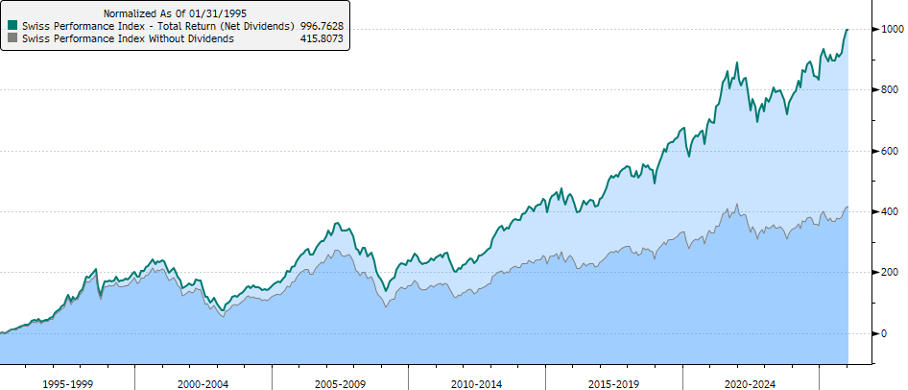
The historic evidence is striking. Swiss total-return indices, which assume the reinvestment of dividends, have significantly outperformed price-only indices over decades, underscoring the structural role of dividends in long-term wealth creation. Importantly, much of this contribution has come from dividend growth rather than yield alone, reflecting the market’s bias toward quality and sustainability.
SPI Swiss performance index with vs without dividends
The Case for Dividend Investing – and Why Swiss Equities Stand Out
Source: PPT 01.01.1995 – 31.01.2026
For investors, Swiss dividend investing offers several practical advantages. Dividend streams are relatively stable and predictable, supported by conservative balance sheets and strong corporate governance. Dividend growth enhances income visibility and helps offset inflation, while CHF-denominated payouts add an additional layer of currency stability. Moreover, in Switzerland - where interest rates have historically been very low and are currently close to 0% - investors value dividends as one of the few remaining sources of attractive income. Finally, dividend-growing Swiss equities have historically exhibited lower drawdowns, making them well suited to long-term, risk-aware portfolios.
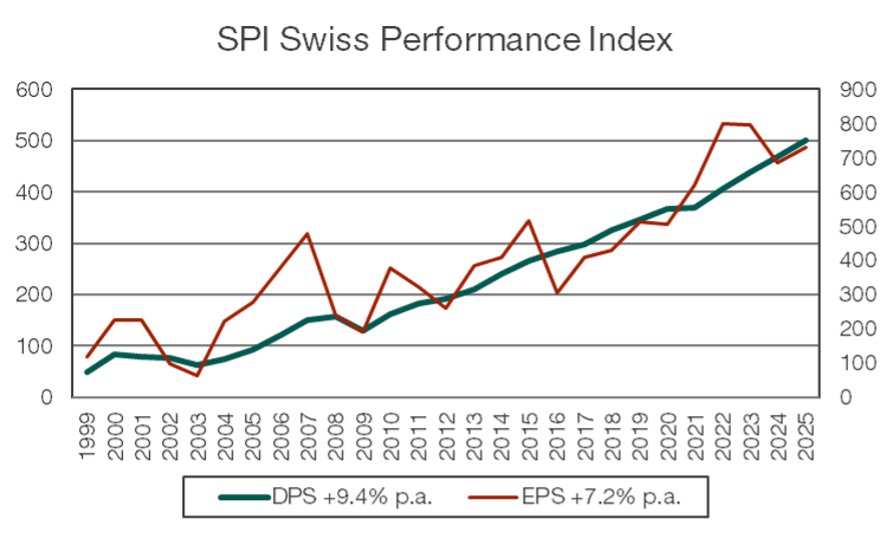
Dividends tend to be much more stable than earnings
The Case for Dividend Investing – and Why Swiss Equities Stand Out
Source: PPT, 01.01.1999 – 31.12.2025
In conclusion, while theory suggests that dividends should not matter, history and real-world constraints demonstrate that they do. More importantly, dividend growth matters more than headline yield alone. Switzerland’s unique equity universe —characterised by quality, discipline and long-term dividend growth — makes it one of the most attractive markets for investors seeking resilient income and enduring total returns.
Our Approach to Swiss Dividend Investing
Our approach builds directly on these principles. We focus on a combination of dividend yield and dividend growth, rather than yield alone. We also incorporate potential share buybacks which have gained in importance in recent years as an increasingly relevant tool for companies to return capital to investors. The strategy invests in leading Swiss companies selected for the strength of their business models, reliable free cash flow generation and their ability to deliver consistent, and long-lasting dividend growth across market cycles.
Using a high-conviction buy-and-hold philosophy, the portfolio is structured around three complementary segments: dividend growers as the core allocation, complemented by selective high-dividend stocks and carefully chosen cyclical or special situations. This balanced approach has proven to deliver above-average income, inflation protection and lower volatility, while maintaining a defensive profile and disciplined capital allocation
By emphasizing dividend consistency, growth visibility and valuation discipline, our investment approach applies these principles within our strategy to capture the full benefits of Switzerland’s high-quality equity universe: resilient income today and growing cash flows for tomorrow.